

Do Companies Keep Cameras In Freezers?
Increasingly intelligent surveillance systems tape every second and keystroke of many workers' days.
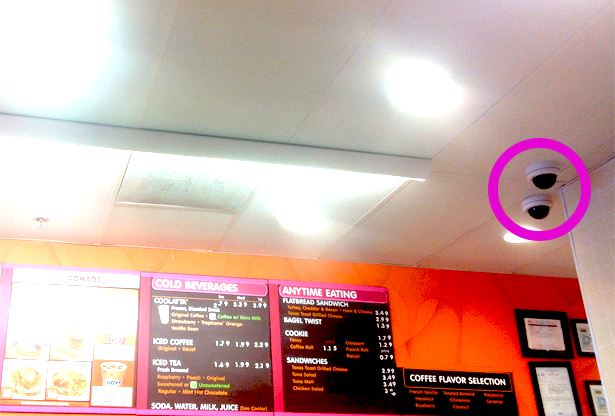
Surveillance cameras in a Dunkin Donuts are highlighted in pink. Image: Megan Garber.
Surveillance technology isn't merely for the FBI and local law enforcement. Corporations see all kinds of potential for combining cheap recording equipment with other types of data collection.
For example, fast food joints, or "quick service restaurants," equally they are known in the trade, lose up to 7 percent of sales to employee theft, co-ordinate to the National Restaurant Association. Now, these retailers are fighting back with surveillance systems that allow them to keep track of their employees every movement and dial of the annals. Already, 90 percent of retailers monitor their staffs with video cameras, only combining the visuals with data from the register makes these systems much more than powerful.
"The earlier utilise of video as a loss prevention tool meant spending hours reviewing footage in order to identify possible culprits," a whitepaper from March Networks, a maker of retail surveillance equipment explains. "Newer video surveillance systems correlate transaction data direct with associated video clips, while the latest business intelligence tools tag certain types of transactions which are most frequently linked to fraudulent activity."
One example, which I spotted in the March/April issue of the merchandise magazine Connected World, comes to us courtesy of Dunkin Donuts. After standardizing its signal-of-sale systems across thousands of stores, they decided to employ one of these "loss-prevention solutions." Here'south how it works, according to Continued World's article:
Past integrating the POS front-of-house system with a loss-prevention system from March Networks, franchisees can search video of employees conducting social club/sales transactions when they suspect theft. Managers tin can wait up videos based on specific search criteria, and so view the videos as well as the dynamic keystrokes [the employees entered]. "This is a very powerful tool to reduce theft in restaurants," Sheehan explains. "We have seen savings between ii-thirteen percent of sales."
To translate: if managers retrieve someone is giving away complimentary food or stealing from the till, every second of his or her workday tin can be reviewed for anomalies. By matching up the keystrokes with the video, managers could detect things similar slipping cash into their pockets or the like.
Information technology's not just fast food joints. All kinds of businesses are taking similar deportment. A convenience store concatenation, Kum & Get, purchased a similar organisation from March Networks and described their feel with it in a whitepaper the visitor released. For a gas station, when someone fills upwardly their tank but so drives off without paying, it's a problem. But information technology could also be a managerial issue, too. How can y'all exist sure that the person working the annals didn't take the money and and so but say that a machine collection off? According to Kum & Go, their surveillance organisation now allows them to see that latter process in action. "Well see the clerk pocket the money and hitting the drive-off central," a Kum & Get manager said. "Nosotros e'er knew this happened, but we could never prove it."
All those piddling things that retail employees do? They're open up to algorithmic and video inspection. It's a bad time to be an immature teenager working at Dunkin Donuts.
There's zero wrong with that, per se. Of course companies desire to reduce the number of employees who steal from them. But some part of me squirms at this pervasive and increasingly intelligent monitoring. Would I really want my boss to accept e'er-on recordings not only of my body but my keystrokes? Would you?
We want to hear what you call up about this article. Submit a alphabetic character to the editor or write to letters@theatlantic.com.
/media/None/image/original.png)
Alexis C. Madrigal is a contributing writer at The Atlantic, a co-founder of the COVID Tracking Project, and the author of Powering the Dream: The History and Promise of Green Technology. He is as well a co-host of Forum on KQED.
Source: https://www.theatlantic.com/technology/archive/2012/04/dunkin-donuts-employee-surveillance-cut-thefts-up-to-13/256152/
Posted by: graberason1943.blogspot.com
0 Response to "Do Companies Keep Cameras In Freezers?"
Post a Comment